Midterm elections often bring uncertainty, headlines, and market volatility. For many investors, political shifts can create concern about how their portfolios may be affected. However, history shows that while elections may influence short-term sentiment, long-term investing principles remain the same.
According to Capital Group’s Guide to Midterm Elections, U.S. markets have displayed several consistent trends during midterm election years. While no election cycle is identical, understanding these historical patterns can help investors stay focused and avoid making emotional decisions based on political noise.

- The Presidents’ Party Often Loses Seats
Historically, the president’s political party tends to lose seats in Congress during midterm elections. Over the last several decades, this has been one of the most common outcomes of midterm cycles.
Markets are generally aware of this trend and often begin pricing in potential political shifts early in the year. While election outcomes can affect policy discussions and legislative agendas, investors should remember that markets are influenced by many factors beyond politics alone, including corporate earnings, inflation, interest rates, and economic growth.
- Market Returns Are Often More Muted During Midterm Years
Data from the S&P 500 Index shows that average returns during midterm election years have historically been lower than in non-election years. Political uncertainty can lead to investor hesitation and slower market momentum throughout much of the year.
However, markets have often recovered as elections approach and uncertainty begins to clear. History suggests that remaining invested rather than attempting to time the market has generally been the better long-term strategy.
- Volatility Tends to Increase
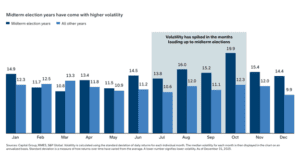
Election seasons naturally create strong opinions, constant media coverage, and uncertainty surrounding future policies. As a result, midterm election years have historically experienced elevated market volatility compared to other years.
Periods of volatility can feel uncomfortable, but they are a normal part of investing. Investors who stay disciplined and focused on long-term goals are often better positioned than those who react emotionally to short-term market swings.
- Markets Have Historically Rebounded After Elections
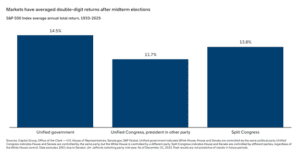
One of the most encouraging historical trends is that markets have often performed strongly after midterm elections. Since 1950, the average one-year return following midterm elections has been significantly higher than average returns during many other periods.
This rebound is often tied to the reduction in uncertainty once election outcomes are finalized. While past performance does not guarantee future results, history demonstrates that markets have shown resilience after periods of political uncertainty.
- Long-Term Returns Have Been Strong Regardless of Political Control
Many investors worry that a specific political party gaining control of Congress or the White House will dramatically impact market performance. However, historical data shows that markets have generated positive long-term returns under a variety of political structures, including unified government and split Congress scenarios.
The takeaway is clear: long-term investment success has historically depended more on staying invested and maintaining a diversified strategy than on predicting election outcomes.
Final Thoughts
Midterm elections can create uncertainty and short-term market fluctuations, but history suggests that investors should remain focused on long-term financial goals rather than temporary political headlines. Volatility is normal, and markets have consistently demonstrated the ability to recover over time.
Instead of trying to predict election results or time the market, investors may benefit most from maintaining a disciplined investment strategy built around their personal goals, risk tolerance, and time horizon.
Source: Capital Group, Guide to Midterm Elections
Content in this material is for general information only and not intended to provide specific advice or recommendations for any individual. This information is not intended to be a substitute for specific individualized tax advice. We suggest that you discuss your specific tax issues with a qualified tax advisor.
This research material has been prepared by LPL Financial
The opinions voiced in this material are for general information only
and are not intended to provide specific advice or recommendations
for any individual. To determine which investment(s) maybe
appropriate for you, consult your financial advisor prior to investing.
All performance referenced is historical and is no guarantee of
future results. All indices are unmanaged and may not be invested
into directly.
There is no guarantee that a diversified portfolio will enhance overall
returns or outperform a non-diversified portfolio. Diversification
does not protect against market risk.
Bonds are subject to market and interest rate risk if sold prior to
maturity. Bond values will decline as interest rates rise and bonds
are subject to availability and change in price.
The S&P 500 is a stock market index tracking the stock performance
of 500 of the largest companies listed on stock exchanges in the
United States. Indexes are unmanaged and cannot be invested in
directly.